what would you use to find a customer who purchased the same item twice sql
QUERYING THE DATABASE: QUERIES and VIEWS
Query: Statement that allows data retrieval
View: A virtual table; a saved query (the SELECT statement, not the result)
SELECT statement (DML)
- retrieves a limited set of data from ane or more tables using criteria specified in the WHERE clause
- frequently used to perform calculations on the data selected
- the result prepare is displayed as a table (columns and rows)
Single-tabular array instance (review):
Current Product List: all data comes from the Products table
SYNTAX
SELECT column list
FROM tablename
WHERE criteria
ORDER BY column listing
Select from two tables: Example
Run the Orders Query (Orders Qry on the Query list): It lists all orders for all customers, without going into line items (order details), past retrieving related data from the Orders and Customers tables.
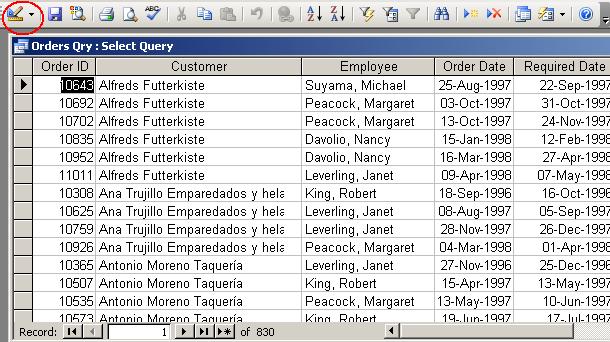
Annotation the number of rows and columns; several columns are repeated more ofttimes than strictly necessary.
SELECT
Orders.OrderID, Orders.CustomerID, Orders.EmployeeID, Orders.OrderDate, Orders.RequiredDate, Orders.ShippedDate, Orders.ShipVia, Orders.Freight, Orders.ShipName, Orders.ShipAddress, Orders.ShipCity, Orders.ShipRegion, Orders.ShipPostalCode, Orders.ShipCountry,
Customers.CompanyName, Customers.Address, Customers.City, Customers.Region, Customers.PostalCode, Customers.Country
FROM Customers
INNER JOIN Orders
ON Customers.CustomerID = Orders.CustomerID;
Annotation: The table names demand not be repeated unless the aforementioned cavalcade names exist in both tables. The table names are but required in the FROM, JOIN, and ON clauses, and in the latter, only because the relating column, CustomerID, has the same proper name in both tables.
The query syntax shown above follows ANSI (American National Standards Institute) rules and should work in the latest versions of all relational databases. Older syntax includes the bring together condition in the WHERE clause (theta style). Note the number of rows and columns in the consequence prepare for the Orders Query and try the same case (with fewer columns), using the older style and table aliases, as follows:
SELECT o.OrderID, o.EmployeeID, o.OrderDate, o.RequiredDate, o.ShippedDate, o.ShipVia, o.Freight, c.CompanyName, c.Address, c.Urban center, c.Region, c.PostalCode, c.Country
FROM Customers c, Orders o
WHERE c.CustomerID = o.CustomerID;
JOIN OPERATOR
The JOIN operator specifies how to chronicle tables in the query. The JOIN operator is one of the set up operations available in relational databases.
The following join types of join are available in nearly relational databases:
INNER
OUTER (LEFT. Right, FULL)
CROSS
Joins may be represented as Venn diagrams, as shown below forth with other mutual set operations:
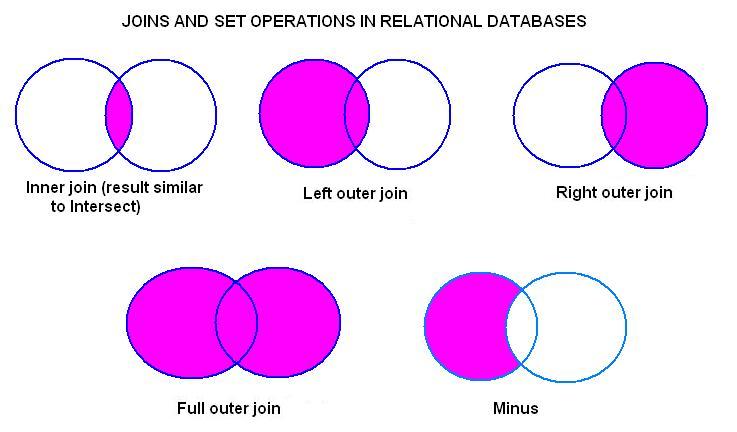
INNER Bring together: Select only those rows that have values in common in the columns specified in the ON clause.
LEFT, Right, or Full OUTER JOIN: Select all rows from the tabular array on the left (or right, or both) regardless of whether the other tabular array has values in mutual and (usually) enter NULL where data is missing. (Notation: FULL OUTER JOIN not implemented in Admission.)
CROSS Join (not illustrated - not exactly a set functioning): Select all possible combinations of rows and columns from both tables (Cartesian product). Not bachelor in Access only tin "happen" by not specifying relationships between tables or non setting upward the appropriate joins in a query. (Non A Expert Affair - the query may run for a very long time and produce a huge, not very useful issue set.)
Access uses the ANSI (American National Standards Institute) style, with the JOIN and ON keywords. Access, MySQL, and Oracle all employ similar syntax, with more join types and options and other set operations in MySQL and Oracle (CROSS JOIN, Full OUTER JOIN, INTERSECT, MINUS).
Select from ii tables: More examples
- Alphabetical List of Products: Lists products that accept not been discontinued and the product category, using all columns from Products (Products.*) and i from Categories:
SELECT Products.*, Categories.CategoryName
FROM Categories
INNER Bring together Products
ON Categories.CategoryID=Products.CategoryID
WHERE (((Products.Discontinued)=No));
- Order Details Extended: Calculates the Extended Price, the discounted total for each line item (order detail) in all orders, using information from the Order Details and Products tables :
SELECT
[Gild Details].OrderID, [Order Details].ProductID, Products.ProductName, [Order Details].UnitPrice, [Order Details].Quantity, [Society Details].Discount,
CCur([Order Details].UnitPrice*[Quantity]*(one-[Discount])/100)*100 Every bit ExtendedPrice
FROM Products
INNER Join [Lodge Details]
ON Products.ProductID=[Order Details].ProductID
Guild BY [Order Details].OrderID;
Select from two tables: Exercises
- Change the Orders query to show only customers from Oregon and list each client's name and address in one case only (i.e., remove redundant columns). Use CompanyName from the Customers tabular array, not from the Orders table (to avoid an Admission-specific lookup). Sort by customer (visitor) proper noun. (Result: 28 rows)
- Text manipulation: Modify the previous query to listing customers from Mexico and Canada, showing metropolis and country in this format:
City, Country (e.one thousand., Montreal, Canada)
with a column header such as ShippedTo or Shipped To. To do this, replace the Urban center and Land columns with ane calculated cavalcade (comma at the end to carve up from the next column if necessary):
City & ", " & Country Equally ShippedTo,
or Metropolis & ", " &
Annotation: Exist certain to find the right names for the City and Country columns - they are unlike in the ii tables. (Result: 58 rows)
- Similarly: List
City, Region PostalCode (e.g.:
Can y'all sort on the calculated cavalcade in the SQL statement? (Result: 152 rows)
SELECT FROM TWO TABLES: SYNTAX
(Recommended, ANSI-style)
SELECT column listing
FROM table1
&nb sp; INNER JOIN table2
&nb sp; ON table1.col1=table2.col2
WHERE criteria
ORDER BY column list
(Older, theta-style)
SELECT column list
FROM table1, table2
WHERE table1.col1=table2.col2
AND other criteria
Lodge BY cavalcade listing
Note:
- col1 in table1 is normally that tabular array'south chief cardinal
- col2 in table2 is a foreign key in that table
- col1 and col2 must have the same data type and for certain information types, the same size
MULTIPLE-Tabular array SELECT
Examples
- The Sales past Category query summarizes sales data ($ figures) for all products, sorted by category, using data from
FROM Categories WHERE (((Orders.OrderDate) Betwixt #ane/ane/1997# And #12/31/1997#)) Group Past Categories.CategoryID, Categories.CategoryName, Products.ProductName Lodge BY Categories.CategoryName;
SELECT Categories.CategoryID, Categories.CategoryName, Products.ProductName, Sum([Society Details Extended].ExtendedPrice) AS ProductSales
INNER Bring together (Products
INNER JOIN (Orders
INNER Join [Order Details Extended]
ON Orders.OrderID=[Order Details Extended].OrderID)
ON Products.ProductID=[Society Details Extended].ProductID)
ON Categories.CategoryID=Products.CategoryID
A bring together condition (ON table1.col1 = table2.col2) must be specified for each join.
If the join is in the WHERE clause, the rules are the aforementioned - the minimum number of join criteria is equal to the number of tables (or views) minus ane.
The GROUP Past clause summarizes data in subsets, in this example giving 1 row per product. (Topic to exist covered in detail in the third form)
The order of clauses in the SQL statement is of import: GROUP BY afterwards WHERE (if present), Lodge Past last.
- The Invoices query pulls together data from all tables except Categories and Suppliers. Run the query, then go to SQL view:
SELECT
Orders.ShipName, Orders.ShipAddress, Orders.ShipCity, Orders.ShipRegion, Orders.ShipPostalCode, Orders.ShipCountry, Orders.CustomerID,
Customers.CompanyName, Customers.Address, Customers.City, Customers.Region, Customers.PostalCode, Customers.Country, [FirstName] & " " & [LastName] AS Salesperson,
Orders.OrderID, Orders.OrderDate, Orders.RequiredDate, Orders.ShippedDate,
Shippers.CompanyName,
[Order Details].ProductID,
Products.ProductName,
[Order Details].UnitPrice, [Order Details].Quantity, [Club Details].Discount,
CCur([Social club Details].UnitPrice*[Quantity]*(1-[Discount])/100)*100 Every bit ExtendedPrice,
Orders.Freight
FROM Shippers
INNER Bring together (Products
INNER Bring together ((Employees
& nbsp; INNER Bring together (Customers
& nbsp; INNER JOIN Orders
& nbsp; ON Customers.CustomerID=Orders.CustomerID)
& nbsp; ON Employees.EmployeeID=Orders.EmployeeID)
& nbsp; INNER JOIN [Club Details]
& nbsp; ON Orders.OrderID=[Club Details].OrderID)
ON Products.ProductID=[Order Details].ProductID)
ON Shippers.ShipperID=Orders.ShipVia;
Exercises
- Create a list of products that shows the category name for each and the contact name of the supplier (77 rows)
- Re-create and salvage either sample query in a higher place with a different name and rewrite with the join criteria in the WHERE clause (theta style).
Tip: To analyze or troubleshoot a query in the Admission query window or in the command line utility in Oracle or MySQL, try breaking the argument as shown in the syntax diagram, with the keywords at the get-go of the lines; or copy and paste to a text editor (e.g., Notepad) and rearrange there.
OUTER JOINS :
Used to find information in one tabular array that is missing related data from another, for example a supplier from whom we have no products, or a product that hasn't been categorized, or a client who has not placed an social club.
Principle: Bring together the tables and find all the rows from one table whose corresponding rows in the other table have a nil value (data missing or value unknown).
Case/exercise
Listing the company proper name, contact person, and phone number of customers who accept not placed orders. Type the following statement in the SQL window:
SELECT CompanyName, ContactName, Phone
FROM Customers
LEFT JOIN Orders
ON Customers.CustomerID = Orders.CustomerID
WHERE Orders.CustomerID is null;
The consequence should exist 2 rows.
In MS Access, this argument is similar to the SQL generated past the Unmatched Query Magician.
Note the emphasis on "related data" above. See whether an outer bring together is necessary to create a listing like the one in the previous example of customers whose orders accept non been shipped. Why or why non?
Queries using set operations
A Spousal relationship query brings together in 1 result set data from two or more than unrelated tables or queries that have identical structure (aforementioned number of columns with same information types occurring in the aforementioned lodge; not necessarily same column headers).
A UNION query cannot be built in the graphical query interface in Access.
Example
Customers and Suppliers past City:
SELECT Urban center, CompanyName, ContactName, "Customers" As [Relationship]
FROM Customers
UNION SELECT City, CompanyName, ContactName, "Suppliers"
FROM Suppliers
Guild BY City, CompanyName;
- Variable number of SELECT statements linked by the key word
- Columns must be named (of import if they were calculated)
- Optional boosted column or columns to add together information or to brand table structures lucifer
- No duplicates unless UNION ALL is specified (non obvious from this example)
- If the result gear up is to exist sorted, just i Order BY clause at the end
- Create an accost list for all employees, customer contacts, and supplier contacts, sorted past proper name. For this exercise, use employee's last name simply.
- Change the previous query to apply the employee's terminal name and first name. (More than than one way to practice this.)
- Modify one of the previous queries to include an additional cavalcade (telephone call it Role) where each person is designated as Employee, Client, or Supplier.
SYNTAX
- Without duplication:
SELECT statement1
SELECT statement2
[...]
SELECT statement-last
ORDER Past cavalcade listing
- To include all rows, regardless of duplication:
SELECT statement1
UNION ALL
[...]
SELECT statement-last
ORDER Past column listing
Other set operators (Oracle): INTERSECT and MINUS
PASS-THROUGH queries
Used when linking one database to another through an ODBC (Open Database Connectivity) or JDBC (Coffee Database Connectivity or Dominicus Java standard) connection. The query written in the local database is "passed through" as is to the database on the server and processed past the remote database.
Examples
- Update values in a remote table
- Observe the next sequence number for a table (Oracle - uses the auxiliary table DUAL in the remote database)
- Run a query using a function or calculation that cannot exist performed in the local database
blackstockweng1992.blogspot.com
Source: https://www1.udel.edu/evelyn/SQL-Class2/SQLclass2All.html
0 Response to "what would you use to find a customer who purchased the same item twice sql"
Post a Comment